

How To Make Hydrogen Sulfide Gas From Household Chemicals
| Writer | Affiliation |
|---|---|
| Sarah Jane D. Reedy, MD | Emory University, Department of Emergency Medicine, Atlanta, GA |
| Michael D. Schwartz, Md | National Center for Environmental Health, Centers for Affliction Control and Prevention, Atlanta, GA |
| Brent Westward. Morgan, MD | Emory University, Department of Emergency Medicine, Atlanta, GA |
Abstract
Introduction:
To assess the frequency of hydrogen sulfide (H2S) suicides and draw the characteristics of victims in the United States (U.S.) since the technique became mutual in Nippon in 2007.
Methods:
To define the frequency of intentional H2S related deaths in the U.Due south. prior to the beginning of the Japanese tendency in 2007, we searched the multiple-cause-of-expiry data from the National Vital Statistics Organisation. To collect every bit much information well-nigh the victims as possible, nosotros sent an email to the National Clan of Medical Examiners (Proper name) listserv asking for their cooperation in identifying cases of HtwoS suicide. To identify cases that were not voluntarily reported past medical examiners but were reported past the media, we conducted Google searches using the search terms: "hydrogen sulfide suicide," "H2South suicide," "detergent suicide," "chemic suicide," and "suicide fad." We obtained all available dissection reports and abstracted information, including the site of the incident, the presence of a note warning others about the toxic gas and the demographic characteristics of the victims. We contacted medical examiners who potentially had custody of the cases that were identified through media reports and requested autopsies of these victims. When unable to obtain the autopsies, we gathered information from the media reports.
Results:
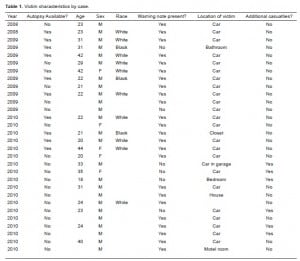
Forty-5 deaths from H2South exposure occurred in the U.S. from 1999 to 2007, all unintentional. Responses from the Name listserv yielded autopsy reports for eleven victims, and Google searches revealed an additional 19 H2S suicides in the U.S. since 2008. Overall (n=30), two cases were identified during 2008, 10 in 2009, and eighteen in 2010. The majority of victims were white males, less than thirty-years-old, left a warning annotation, and were found in cars. There were five reports of injuries to first responders, just no secondary fatalities.
Decision:
H2South suicides are increasing in the U.S., and their incidence is probably underestimated by public health officials and physicians. First responders are at take chances when assessing these victims due to the severe toxicity of the gas. Emergency providers must be aware of HtwoDue south suicides to educate others and care for the rare survivor.
INTRODUCTION
Hydrogen sulfide (H2South) is an infrequent simply well recognized occupational and industrial hazard and is a cause of substantial morbidity and mortality. Typical occupational scenarios involve exposure to high concentrations of HiiDue south gas released from petrochemical plants, sewers, volcanoes, or manure pits. Fatalities of workers and rescuers involved in these incidents have been reported extensively.1 – 6 The toxicodynamic effect of H2South is similar to cyanide in that it binds to cytochrome-c oxidase and is classified as a cellular asphyxiant. High concentrations of H2S are associated with sudden loss of consciousness (the and so-called "knockdown" outcome), apnea and rapid decease. Lower level exposures have resulted in pulmonary edema and keratoconjunctivitis among survivors.7
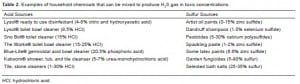
Fatal intentional exposures in the Usa (U.S.) have not been described in the medical literature; however, suicides using HtwoSouthward have been described in Japan since 2007.8 These suicides have been dubbed "detergent suicides" by the media considering they are carried out by mixing household chemicals (oft an acidic toilet bowl cleaner as a proton donor and insecticides or bathroom salts as a sulfur source) to produce toxic concentrations of H2S gas.ix The specifics of this technique became available on Japanese websites in belatedly 2007. It is idea that availability of this information contributed to a dramatic increase in the number of these cases reported.10 , 11 In 2007, there were only 27 cases of HtwoS suicides in Japan; all the same, 517 cases were reported betwixt January and July in 2008.7 To date, there has not been a comprehensive survey for fatalities from intentional inhalation of HiiS gas in the U.S. Furthermore, because at that place is no unmarried database for reporting causes of death or methods of suicide, it is likely that the prevalence of this "fad" may be underestimated by public health officials and emergency responders, the latter being at increased risk when attempting to extricate patients or victims from an environment of highly toxic H2S. Through exploring the characteristics of these patients, nosotros hope to educate emergency providers most the dangers posed by this novel suicide technique.
METHODS
To ascertain the frequency of intentional H2S related deaths in the U.S. prior to the start of the Japanese trend in 2007, we searched the multiple-cause-of-expiry data from the National Vital Statistics System (NVSS) bachelor via the National Center for Health Statistics (NCHS) at the Centers for Illness Control (CDC). Bloodshed data from the NVSS are a fundamental source of demographic, geographic, and crusade-of-death information. These data are provided through contracts betwixt NCHS and vital registration systems operated in the various jurisdictions legally responsible for the registration of vital events and are considered the nearly comprehensive source of vital statistics in the U.S. These data are bachelor to the public for query on the CDC website.
To collect equally much information about the victims as possible, we sent an email to the National Clan of Medical Examiners (Proper name) listserv request for their cooperation in identifying cases of self-inflicted H2South poisoning. All information obtained was voluntarily contributed by medical examiners and was compliant with the Wellness Insurance Portability and Accountability Human activity regulations. All documents were transmitted past secure fax or by mail; all autopsies and patient identifiers were kept in a locked file cabinet. Medical examiners adamant that the crusade of death was H2S in these cases based on the conditions of the effect, such as presence of "rotten egg odor" in the environment and the presence of chemicals on scene that produce HiiDue south in sufficient concentrations as to cause death. To identify cases that were not voluntarily reported by medical examiners simply were reported by the media, we also conducted multiple Google searches using the search terms: "hydrogen sulfide suicide," "H2Southward suicide," "detergent suicide," "chemical suicide," and "suicide fad."
Once cases were identified, we then obtained all available dissection reports and abstracted information including the site of the incident, the chemicals used, the presence or absence of a annotation warning others about the toxic gas, and the demographic characteristics of the victims, mainly age, gender and race. We contacted medical examiners who potentially had custody of the cases that were identified through Google searches and media reports and requested autopsies of these victims. When unable to obtain the dissection reports, we gathered as much information as possible from the media reports themselves.
RESULTS
According to the multiple-crusade-of-expiry data from the NVSS, NCHS, there were 45 deaths from H2S exposure in the U.S. from 1999 to 2007, but all were deemed unintentional. To date, the NVSS has but been compiled through 2007, thus information technology could not exist queried for deaths occurring from 2008–2010. Responses from the Proper noun listserv research yielded full autopsy reports for 11 victims from 2008 to 2010. Google searches revealed an additional 19 H2South suicides in the U.S. since 2008. The sentinel case was identified past Google search and occurred August 26, 2008. The most recent case was also identified via Google search and occurred Oct 1, 2010. Overall (north=30), only 2 cases were identified during 2008, followed past 10 cases in 2009, and 18 in 2010. Victims were identified in 12 dissimilar states. The majority of victims were male (83%). 10 victims were identified as "white," three were identified as "black," and the remaining 17 had no racial identifiers. Age was bachelor for 23 of the victims, who ranged from 20 to 44 years of age. Fourteen victims were less than thirty years of age. Xx-four of the victims left notes warning neighbors and get-go responders of the potentially hazardous chemical suicide underway. Twenty-three (77%) victims were found in cars. There were five reports of injuries to starting time responders, but in that location were no secondary fatalities. The specifics of injuries to first responders were not available, however at least three required evaluation in the emergency section (ED).
Discussion
"Detergent suicides" are becoming increasingly common in the U.Southward. Following the ii sentinel cases in 2008, the number of victims increased five-fold in 2009, and nearly doubled again in 2010. The characteristics of this population are similar to other high fatality suicide modalities in that the bulk of victims for whom demographic data is bachelor are white males. As is referenced on the Japanese websites, it appears that the bulk of victims believed that they were being considerate of kickoff responders past selecting enclosed environments (such every bit cars and closets) and posting notes warning them of the toxic gas inside. In this survey, however, at that place were reports of injuries to five kickoff responders. This clearly demonstrates that HiiSouthward suicides institute a threat to kickoff responders, and that recognition of potential HiiS scenarios and advisable personal protective equipment should exist discussed to foreclose farther morbidity and mortality.
Overall, it seems probable that nosotros can await the frequency of H2S suicides to increase as this method is popularized in media coverage of these deaths and more websites appear offering guidance on this issue. Additionally, the household chemicals needed to create toxic concentrations of HtwoSouth gas are myriad and readily bachelor in stores and on the internet. Given the facts that there were no H2S suicides reported in the NVSS through 2007 and no media reports of H2S suicides prior to 2008, information technology seems articulate that this reporting represents an actual increment in cases and not simply an increase in media reporting of such events.
As emergency providers it is critical to be aware of this practice in order to adequately assess and educate bystanders and first responders after not-fatal exposures, as well as provide advisable care to the rare victim that survives the initial attempt. To date, there have not been whatever fatalities amid first responders involved in these incidents; however, ii emergency medical technicians in North Carolina were sent to the ED for irritant respiratory symptoms after attempting to rescue a woman from her car when no warning sign was posted.12 Furthermore, an incident in Japan in which a 14-year-old girl committed suicide with H2Due south resulted in 90 sick neighbors later the gas seeped into adjacent apartments.13 These events illustrate the potential for inadvertent casualties associated with these suicides and highlight the demand to educate ED providers regarding management of H2South exposures.
Additionally, this study demonstrates a need for change in health policy to address the need for quicker broadcasting of suicide statistics to prompt early implementation of prevention strategies. Furthermore, the fact that the bulk of H2S suicides were publicized on the internet or on television news highlights the responsibility of the media in disseminating perhaps more information than is prudent when discussing novel suicide techniques. There is a role for public health officials in addressing the manner and extent of such potentially destructive data when shared with the general public.
LIMITATIONS
This written report is limited in that cases were referred by medical examiners on a voluntary basis merely or when a publically available account (i.e. internet) could be attributed to the right medical examiner. It is likely that there may exist additional cases that were not captured in our query of medical examiners via listserv. Furthermore, it is also possible that additional H2South suicides occurred that were non reported in the media, and therefore not identified by Google searches. Assay of the descriptive characteristics of these events was also express past the lack of availability of total autopsy reports for 19 of the 30 victims.
CONCLUSION
To date, the incidence of suicide past intentional inhalation of homemade H2Southward gas is probably underestimated by physicians and public health officials. Information technology seems likely that we can expect these rates to increment as H2Southward suicides are popularized in media coverage of these deaths and more websites appear offering guidance on this issue. Public health officials should exist aware of this disturbing trend in lodge to implement plans for prevention of morbidity and mortality due to intentional H2S exposure. Furthermore, first responders must be knowledgeable virtually these events to protect themselves when approaching a potential H2S victim.
Footnotes
Supervising Section Editor: Monica H Swahn, PhD, MPH
Submission history: Submitted January 18, 2011; Revision received March 3, 2011; Accepted March 4, 2011.
Reprints available through open up access at http://escholarship.org/uc/uciem_westjem.
Address for Correspondence: Sarah Jane D. Reedy, Doctor
Emory University, 2605 Woodridge Dr., Decatur, GA 30033
Electronic mail: sjreedy@gmail.com
Conflicts of Involvement: Past theWestJEM commodity submission agreement, all authors are required to disclose all affiliations, funding sources, and financial or management relationships that could be perceived as potential sources of bias. The authors disclosed none.
REFERENCES
ane. Hoidal CR, Hall AH, Robinson MD, et al. Hydrogen sulfide poisoning from toxic inhalations of roofing cobblestone fumes. Ann Emerg Med. 1986;15:826–30. [PubMed]
2. Hall AH, Rumack BH. Hydrogen sulfide poisoning: an antidotal function for sodium nitrite? Vet Hum Toxicol. 1997;39:152–4. [PubMed]
3. Gregorakos L, Dimopoulos G, Liberi South, et al. Hydrogen sulfide poisoning: management and complications. Angiology. 1995;46:1123–31. [PubMed]
four. Fuller DC, Suruda AJ. Occupationally related hydrogen sulfide deaths in the United States from 1984 to 1994. J Occup Environ Med. 2000;42:939–42. [PubMed]
5. Occupational fatality following exposure to hydrogen sulfide–Nebraska. MMWR Morb Mortal Wkly Rep. 1986 Aug 22;35:533–5. [PubMed]
half-dozen. Policastro MA, Otten EJ. Case files of the University of Cincinnati fellowship in medical toxicology: two patients with acute lethal occupational exposure to hydrogen sulfide. J Med Toxicol.2007;3:73–81. [PMC costless commodity] [PubMed]
7. Guidotti TL. Hydrogen Sulfide. In: Shannon One thousand, editor. Haddad and Winchester'southward Clinical Management of Poisoning and Drug Overdose. 4th ed. The states: Saunders; 2007.
8. Kobayashi K, Fukushima H. Suicidal poisoning due to hydrogen sulfide produced by mixing a liquid bathroom essence containing sulfur and a toilet bowl cleaner containing hydrochloric acid.Chudoku Kenkyu. 2008;21:183–viii. [PubMed]
nine. Iseki 1000. Hydrogen sulfide poisoning and the internet. Chudoku Kenkyu. 2009;22:315–ix. [PubMed]
x. Poulsen K. Dangerous Japanese "detergent suicide" technique creeps into U.South. 2009.http://www.wired.com/threatlevel/2009/03/japanese-deterg/. Accessed September nine, 2010.
11. Morii D, Miyagatani Y, Nakamae N, et al. Japanese experience of hydrogen sulfide: the suicide craze in 2008. Occup Med Toxicol. 2010;5:28.
12. Davis S, Hartness Due east. Toxic stew of household chemicals found with dead woman. Available atwww.WRAL.com. Accessed September nine, 2010.
13. Associated Printing. Japanese Daughter Commits Suicide With Detergent, Sickens xc Neighbors.Available at www.foxnews.com April 24, 2008, Accessed September ix, 2010.
Source: https://westjem.com/articles/suicide-fads-frequency-and-characteristics-of-hydrogen-sulfide-suicides-in-the-united-states.html
0 Response to "How To Make Hydrogen Sulfide Gas From Household Chemicals"
Post a Comment